UAdvocacy
The Sexual Assault Reporting Process at UAlbany
Navigating resources after an assault can be overwhelming. Where do you start?
Erin Odell

The entrance to the Office of Health Promotion, located in Seneca Hall's basement on Indigenous Quad. Photo by Erin Odell
Not every victim is comfortable with filing reports about their assault, for many reasons. No one wants to be pushed into a legal case. On college campuses especially, it’s important to have supplemental resources for victims in addition to Title IX. When a UAlbany student is faced with this dilemma, how do they figure out what path to take?

There’s a few main resources to consider: The Office of Health Promotion (OHP), Albany County Crime Victim and Sexual Violence Center (CVSVC), Counseling and Psychological Services (CAPS),and the Office of Equity and Compliance (Title IX Coordinator).
The Office of Health Promotion is a great place to start. They were previously “required to report disclosures of sexual misconduct to the Title IX Coordinator,” according to their website. I spoke with MacKenzie Bachar, the office’s Sexual Violence Prevention Specialist, who told me this has changed this semester. Now, OHP will not share any information with campus resources, Title IX included, “unless a student asks us to.”
_JPG.jpg)
Mackenzie Bachar, the OHP'S Sexual Violence Prevention Specialist. Photo provided by Mackenzie Bachar.
“Say that the student decides to go to court, like criminal court. And they’re pressing charges against the person that offended them- we could be subpoenaed to share information in court,” Bachar stated. As a result, they try to work more with campus resources to protect confidentiality.
OHP offers support in several ways; The website lists that they can help students: “Process experiences of violence and harm in a supportive but non-clinical manner, weigh options and outcomes of possible action steps, create a safety plan and arrange accommodations, meet with campus administrators and communicate with professors.”
“First, we’re going to assess what the situation is, and the comfort level. We’re going to work with that person on what resources they’re looking for. Navigating resources is the first thing we’re doing,” Bachar said. Does the student need new housing? An order of protection? To pursue a criminal case? Bachar continued, “What are these resources you need access to? Do we have access to them on campus? And creating that direct pathway to it if there's not access to it on campus. Where is the access, and pretty much stepping into that system with the person to get the access that they need.”
OHP may connect you to CVSVC. The Center has an advocate on campus Tuesdays from 3pm to 4:30pm in the Office of Health Promotion. It also has an online chat that is usually open from 10am to 2pm during the weekdays; However, it is currently out of service due to staff shortages. Luckily, they still take appointments through the phone and their hotline runs 24/7.
While OHP and CVSVC helps you with accommodations across campus (and/or elsewhere), you may still be seeking ways to process your situation. One on-campus resource OHP may suggest is CAPS.
Another confidential on-campus resource, CAPS “provides compassionate, confidential and inclusive mental health care to registered UAlbany students. All services are covered by your tuition and fees,” according to their website. They provide several types of counseling and treatment. Victims would likely fall under the section “Counseling related to Adverse Experiences.” You can meet with the Trauma & Resilience Specialist “to discuss your concerns and needs, and to plan for your short- and long-term care.”
Lastly, the Title IX Coordinator. This is pretty much viewed as the legal route, although there’s some overlap with OHP. They’re listed as responsible for “Responding to all reports of sexual misconduct, under the Title IX reporting process; Providing information about on- and off-campus support services; Helping community members access academic, residential and safety accommodations, regardless of whether a complaint is filed; Conducting prompt, fair and unbiased administrative investigations into allegations of sexual misconduct to determine if there was a violation of UAlbany policy.”
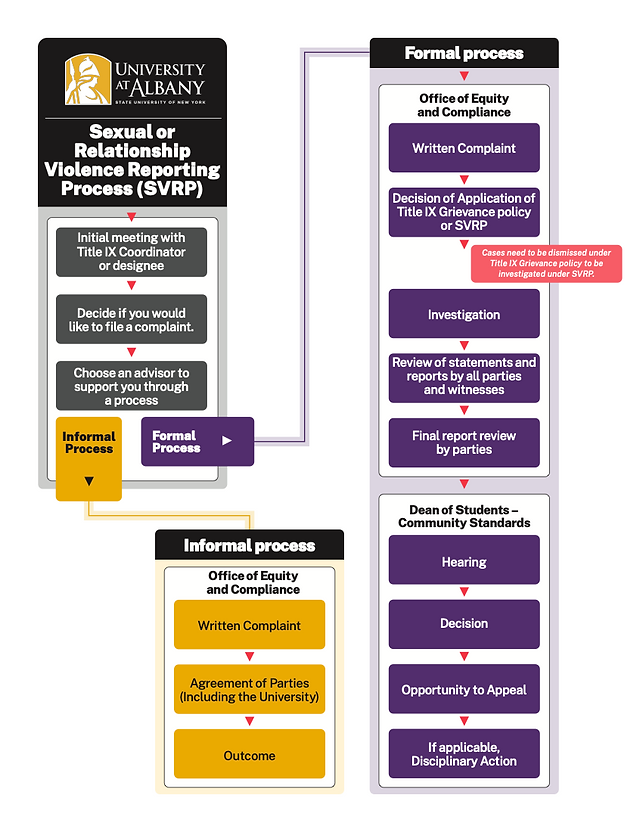.png)
A reporting individual can choose to go through the informal or formal complaint processes. I’ve seen a few students settle for just a cease-and-desist, which doesn’t require a formal written complaint. This may not be everyone’s preferred choice as they “may be appealed and are not considered discipline. These orders do not become part of a student’s conduct record, unless violated,” according to the UAlbany website.
To make the information easier to digest, the University has a flow chart outlining the reporting process when the accused party is another student. The informal route is pretty simple: Written complaint, have all parties agree, Informal Resolution Agreement. As for the formal complaint process, after your written complaint the Title IX Coordinator will decide whether case is under the Title IX Grievance Policy or the Sexual Violence Response Policy.
Next, the investigation. This includes interviews with parties and witnesses in addition to statements and evidence. After all parties review their statements, the Investigation Report is sent to the Dean Of Students office, more specifically the Office of Community Standards. The accused will be asked to review the student conduct process with them. Next, the Office of Community Standards will hold a hearing. If the board decides the accused has violated the code of conduct, disciplinary action will be taken. Both parties can appeal the decision.
This is not meant to be an encyclopedia of what to do at UAlbany after an assault- but it’s a good place to start. There’s simply too much information to put in one place, especially when considering the different options. The goal is that someone reads this and are able to use it to help decide where to seek support.